


Clever Furniture Choices for Tiny Flats and Lofts
Look for nesting tables, wall-mounted desks and storage beds that serve two purposes without crowding your floor plan.

Start with the floor, not the furniture
In a tiny flat or loft conversion, clear floor is the most valuable thing you own. Every piece of furniture sitting on it makes the room feel smaller; every piece that folds, stacks or mounts on a wall gives some space back. The goal isn't to live with less — it's to choose pieces that do two jobs at once.
Loft rooms add their own complications. Sloped ceilings, dormer windows and low eaves mean standard furniture often won't fit where you want it. Before you buy anything, measure the usable height at the lowest point of the ceiling, and note where headroom drops below about 1.2 metres. That's the zone for low drawers or a built-in bench — not a full-height wardrobe.
Tables that nest, stack and disappear
Nesting tables are the single best-value purchase for a small living room. A set of two or three slides together into the footprint of the largest one, so you can have a coffee table day to day and pull out a side table when someone visits. Look for sets where the smaller tables tuck fully underneath the largest, rather than sitting proud and catching your shins.
Stacking stools work the same way. Four lightweight stools that stack to the height of one can be a coffee table with a tray on top, extra dining seating, or bedside tables. If you have a dining area, consider a drop-leaf or gateleg table: it can sit against a wall at 60cm wide and open to seat four. Wall-mounted versions, fixed with sturdy brackets, leave the floor completely clear when folded down.
Round tables are worth considering too: in a tight corner, they let you move around more easily than a rectangular one of the same seating capacity.
Wall-mounted desks for tight corners
A loft room often has a window wall that's perfect for a desk but no floor space for a full-sized one. A floating desk, fixed to the wall at 72–75cm high and 45–50cm deep, gives you a proper workspace with nothing underneath. Add a wall-mounted shelf above for a lamp and stationery, and you've got a study corner that takes up no floor at all.
If you need to hide the desk away, a fold-down version is the answer. These hinge flat against the wall and can double as a console table in a hallway or a dressing table in a bedroom. Just check the depth when folded — a desk that protrudes 15cm is fine; one that sticks out 40cm is a hazard.
For a bedroom desk, consider a slim, wall-hung unit with a single drawer, or a ladder-style shelf that sits over the desk to hold books and plants. The key is to keep the legs off the floor.
Beds that earn their keep
Beds take up the most space in any small home, so they should work hardest. An ottoman bed with a gas-lift mechanism gives you the whole area under the mattress as storage — often the equivalent of a large chest of drawers. A divan with drawers is a close second and easier to access daily.
In a child's room or guest room, a cabin bed or high sleeper turns the space under the mattress into a desk, a wardrobe or a play area. A daybed with a trundle is another good option: a sofa by day and two beds by night. If the room has low eaves, a low platform bed with drawers underneath may be the only sensible fit — measure carefully before ordering.
Whatever you choose, make sure the storage is easy to reach. A bed that needs pulling out and lifting every morning will soon be ignored.
Storage that climbs the walls
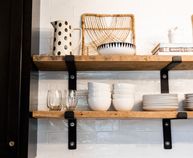
When floor space runs out, go up. Floor-to-ceiling shelving in an alcove or beside a chimney breast uses height instead of width. Wall-mounted hooks, a pegboard above a desk, and over-door organisers all add storage without taking up a single centimetre of floor.
- Alcove shelving: take shelves to the full height of the alcove and use baskets at the bottom for bulky items.
- Pegboards: brilliant above a desk for hanging utensils, cables and tools.
- Over-door racks: for shoes, cleaning supplies or towels in a bathroom or hall.
- Under-stair drawers: often the largest unused storage volume in a flat.
- Bedside shelves: a small wall shelf frees up the floor where a table would sit.
Keep the top of wardrobes and shelves for things you rarely use, and eye-level zones for everyday items. That way the room feels tidy without much effort.
A few practical rules before you buy
Measure twice — and measure the access route as well as the space. A sofa that fits the room but not the stairwell is no use. Check door widths, turn angles on stairs and tight corners; loft conversions often have a narrow or winding staircase.
Choose furniture with legs or a raised base where you can. Seeing floor underneath a piece makes a room feel larger than a solid block sitting flat on the carpet. Light colours and reflective surfaces help too, but function comes first: a pale sofa you can't sit on comfortably is a false economy.
Finally, buy for the life you actually live. If you never eat at a table, don't sacrifice floor space for one. If you work from home three days a week, a proper desk beats a decorative console. In a small flat or loft, every piece has to justify its place — and the best ones do two jobs at once.

Post a comment